YouTube Isn’t Art
Exploring Why YouTube Hasn’t Surpassed Traditional Entertainment Yet
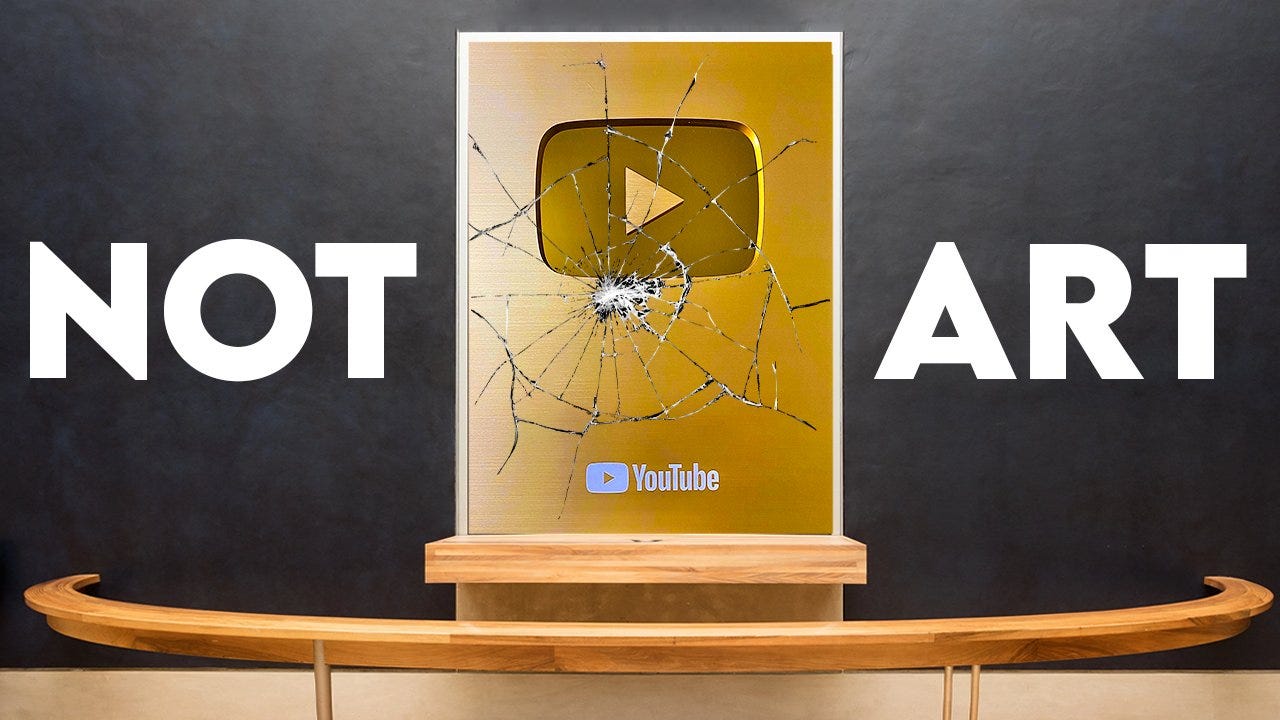
There’s a rhetoric that traditional has been surpassed by digital but this couldn’t be further from the truth. Movies and TV still dominate the pop culture conversation, starring in a Netflix show can catapult you to A-list status, and one of the shining examples of YouTube’s dominance over the mainstream, MrBeast’s SquidGames video (which is the most viewed on his channel) wouldn’t have been as successful or even existed, without traditional.
This shouldn’t make sense. YouTubers pull tens, sometimes hundreds of millions of views a month, make millions of dollars every year, and have a strong connection with their audience. But despite all of that, they’re missing something. That thing is art.
YouTubers Are Bad Storytellers
Ask anyone what their favourite stories of all time are — not a single person will say a YouTube video. Creators have a tendency to get caught up in their own eco-chambers and compare their storytelling to their peers, which in that context is better than it’s ever been. But when compared to the stories we’re seeing on platforms like HBO and Netflix, it’s not even close.
Why aren’t YouTubers telling great stories? In a word, data. On a scale of Artist to Distributor, creators lean heavily towards distribution, they’d rather find hacks to increase their retention and click-through-rate than tell better stories. In a creator culture that is hyper-focused on these two metrics, spectacle is king. High concepts get people to click and fast paced action keeps audiences engaged numbed so they keep watching. Spectacle works best when it’s married with story but it appears the bride got cold feet and skipped the wedding.
One of the greatest living filmmakers today, James Cameron has combined story and spectacle throughout his career. Terminator, Titanic, and Avatar are all high concept action films grounded in a deeper narrative. Is there a place for pure spectacle? Sure, people loved to be entertained. There’s a reason that there’s 10 Fast and Furious movies (nine franchise and one spinoff). Collectively, they’ve earned over $6.6 billion at the box office, which is a staggering number until you compare it to James Cameron who has outsold the entire Fast Franchise with just three three movies. Spectacle only gets you so far.
YouTube is currently in its “Fast and Furious phase”, the smallest elements of story are present but they just act as the reason to get to the spectacle, nothing more. Why does it matter? Because the creatives that stand the test of time are the ones that are great at storytelling. Spectacle entertains you in the moment, but that moment is fleeting. Do you even know who directed the first Fast and Furious? No? His name is Rob Cohen. Can you name any of his other films? Also no? It’s almost as if people don’t connect with something that they don’t emotionally resonate with.
Are You Making Art or Are You Making Media?
Telling great stories is an artform. To tell a great story, you need to care about what you’re making, you need to have intention. The problem is, YouTubers don’t actually care about what they’re making, they just want attention.
Creators churn out videos at a staggering rate, all in service of getting more views. They’re on a production line of content, when one video is released, the next is being edited, meanwhile they’re working on the thumbnail for a third, filming a fourth, and ideating a fifth. Art takes time, YouTubers have none.
Art is “producing works to be appreciated primarily for their beauty or emotional power” whereas media is “the main means of mass communication (broadcasting, publishing, and the internet)”. Media is creating things to be heard, art is creating things to be felt. This here, lies the reason as to why creators aren’t telling great stories, because they’re creating media and not art. Media is the plural of medium, which is “an agency or means of doing something” but medium also refers to “the middle quality or state between two extremes”. Creators aren’t telling bad stories, but they aren’t telling good ones either… they’re somewhere in the middle.
It’s important to know whether you’re making art or you’re making media. These are two different things, with two different approaches, and two different measurements of success. Most creators are making media, but they actually want to be making art. Want proof? Tell your creator friends that what they make isn’t art. Watch them instantly become defensive and disagree with you.
The most ideal scenario for any artist is to be able to make whatever they want. Most people think that becoming a full time creator will allow them to do just that. But instead they wind up having to make whatever will appease their audience. It’s not uncommon for a creator to go viral for one type of content and be stuck making the same thing over and over again to get views. This leads to a crisis of conscience because despite becoming a full time creator and getting everything you’ve ever wanted, you’re empty. It’s a meaningless pursuit to make media you don’t care about. There’s meaning in art.
This is the reason why, despite having money and success, YouTubers will still try to make the jump to traditional. Making media will never fully satisfy someone who’s artistic at heart. But then again, maybe you want to make media. Maybe media is your art form, there’s nothing wrong with that. Media is powerful, it can influence art, not through its message but through its format.
YouTube Killed the Reality Star
On August 1st, 1981 MTV came on the airwaves with a statement. The first music video they ever played was Video Killed the Radio Star. This song choice could not have been more prophetic as Music Television would go on to revolutionize the music industry, and pop culture at large. At the time, music videos were an afterthought, not many bands made them and if they did, it was hard to convince their labels to provide them to the station.
When record executives realized that getting your video played on MTV had an impact on sales they changed their tune. Music went from an audible artform to a visual medium. If we zoom out even further, these videos started to influence another artform, filmmaking. Not only did the music in movies start to change but how movies were made altogether changed. Music videos were known for fast moving stories, quick edits, and special effects and all of these elements started to find their way to Hollywood to satisfy the “MTV generation”.
The very same impact that MTV had on pop culture is now being replicated by creators. Music is being made with the goal of enticing popular TikTokers to use it in their videos and the YouTube trademarks of fast moving stories, quick edits, and unabashed exposition have started to find their way to Hollywood to satisfy the “dopamine generation”.
What’s most impressive about MTV is not only did they change pop culture once, they did it twice. What started as a platform for music videos evolved over time to pioneer reality TV. The Real World debuted in 1992 and is widely considered to be the birthplace of modern reality television. Once they found success with this format they continued to innovate on it; going from the lives of regular people to celebrities, stunts, house tours, and more. In fact, a lot of the formats we see on YouTube today are descendants of MTV shows. But now, the student has surpassed the teacher, YouTubers are currently making the best reality TV on the planet.
MTV on the other hand, is a shell of its past self. They’ve stopped redefining their shows and have started recycling them. Jersey Shore was huge, you know what hasn’t been? Buckhead Shore or Floribama Shore. 16 and Pregnant has given birth to 16 and Recovering. There are five different versions of “The Challenge” and Ridiculousness has led to the ridiculousness that is Adorableness, Deliciousness, and Messyness. MTV fell off, not because they stopped doing music videos, but because they stopped innovating.
YouTubers are toeing the line that MTV ran past en route to its downfall. The life-cycle of a creator right now is to find a format that works, bleed it dry, panic because you’re losing relevancy, and then start copying other successful videos to inflate your metrics so you can feel good about yourself again. Where MTV went wrong is they started rinsing and repeating the same type of show over and over again and people got bored. Creators think the key to success is copying what’s already worked, but MTV has shown us it’s the opposite.
The YouTubers who will stand the test of time are the ones who are able to not only find a format that works, but innovate on it to keep it fresh. MrBeast, Airrack, and Ryan Trahan have all done a great job of elevating and evolving their content over time and as a result are some of the most popular creators in the world right now… but that doesn’t mean they’re making art.
Follow the Money
Don’t misconstrue art and creativity for the same thing. YouTubers might not be making art but they are incredibly creative. There’s a lot of talent in the creator world, there’s just not a lot of artistry. But why not? Why do creators continue to make media when they’d rather make art? Because of the incentives.
YouTube isn’t set up to let art thrive. This may seem odd because it’s an entertainment platform, except for the fact that it’s not. It’s an advertising company. YouTube makes money through advertisements, therefore its algorithm will optimize for content that enables them to serve more ads so they can make more money. YouTube doesn’t care what you make, as long as it’s brand friendly and gets seen by lots of people. Further, YouTube incentivizes creatives to adhere to this model because they split the advertising revenue with them. As a result, YouTubers optimize their content to satisfy the algorithm so that they can get more views and make more money. Creators don’t care what they make, as long as it’s brand friendly and is seen by lots of people.
What’s the best way to be seen by lots of people? By making media because it’s “the main means of mass communication (broadcasting, publishing, and the internet)”. What do you do when you put out a new video on YouTube? You publish it… on the internet… in hopes of it being seen by a broad audience.
As soon as the profit engine is around viewership, your incentives change and you start making media. Media monetizes through attention, art monetizes through intention. You consume media by seeing a title or a thumbnail that gets your attention. You consume art by intentionally choosing to consume it. Nobody ever spends a long time trying to find a YouTube video to watch, but they will take their time when choosing a movie on Netflix.
Media is marketing. Art is impact. Art that permeates our culture has to resonate with the audience otherwise it fades away. Media on the other hand, doesn’t need to resonate, it just needs to get your attention and it’s able to do that over and over again with sensationalist headlines, ridiculous concepts, and cheap drama.
If creators are incentivized to get views, they’ll continue making media. If they continue making media, they won’t be telling great stories. If they aren’t telling great stories, they’ll never surpass traditional entertainment.
It’s Been Done Before
A shift from media to art has already taken place within traditional itself. Television started as media. Its business model was predicated on maximizing viewership so that they could make more money on ads. Sound familiar? During this era, TV sat in the shadow of film. You were able to tell stories on the big screen that were unimaginable on the small one.
The exception to the rule was HBO. Despite being a television company it consistently released some of the greatest stories ever told. The only problem with that argument is HBO is not the exception to the rule, it proves its existence. Because HBO has never had advertisers, it’s been a subscription business since it launched in 1972.
The subscription business model changes the incentives around what you are creating. You’re no longer trying to optimize your content to get as much attention as possible, you’re trying to release the highest quality content imaginable to convince your subscribers to continue paying you every month.
It’s no coincidence that the debate about whether TV was better than movies started gaining momentum as more and more streaming services came into prominence. All of these platforms are subscription based which means they win by releasing the best content and telling the best stories. Television started overtaking movies when it stopped being media and started being art.
YouTube Will Never Be Mainstream
YouTubers haven't surpassed traditional because they aren’t running the same race. Traditional is playing an artistic game while YouTube is playing a media one. This doesn’t mean that creators can’t overtake TV and film one day, they absolutely can.
Creators have already surpassed reality TV, which is truly astounding. A bunch of kids in their bedrooms overtook an entrenched industry with decades of experience and millions to spend. Even though the deck was stacked in traditional media’s favour, creators proved you should never bet against them.
YouTube will never be mainstream. Creators will. You can’t charge for what was once free, we’ve seen that with the now defunct YouTube Originals and the struggling YouTube Premium. YouTube doesn’t need to charge though, its advertising continues to bring in billions of dollars every single month. And as long as that continues to happen, it won’t change. That burden falls on the creator.
If creators want to truly surpass traditional media then they have to start telling better stories. In order to tell better stories, they need to be making art and not media. In order for them to make art and not media their incentives need to change. In order for their incentives to change they need to become unreliant of YouTube.
The problem is, creators feel the need to appease the algorithm. They can make whatever they want but instead create what they think they have to, to get views. This has led us to a world where there are incredibly talented individuals wanting to make art but settling for media. You can’t argue that creators are making exactly what they want when everyone is making the same thing.
Artists can make media. They can make great media, but it will never be as satisfying as creating something that emotionally resonates with an audience. The talent to make art is there, and so is the choice. The power is in the hand of the creator now more than it has ever been. You can make whatever you want, and tell the story you’ve always wanted to tell. The only person stopping you, is you.