The Death of Imagination
Thoughts on second order effects of globalization.
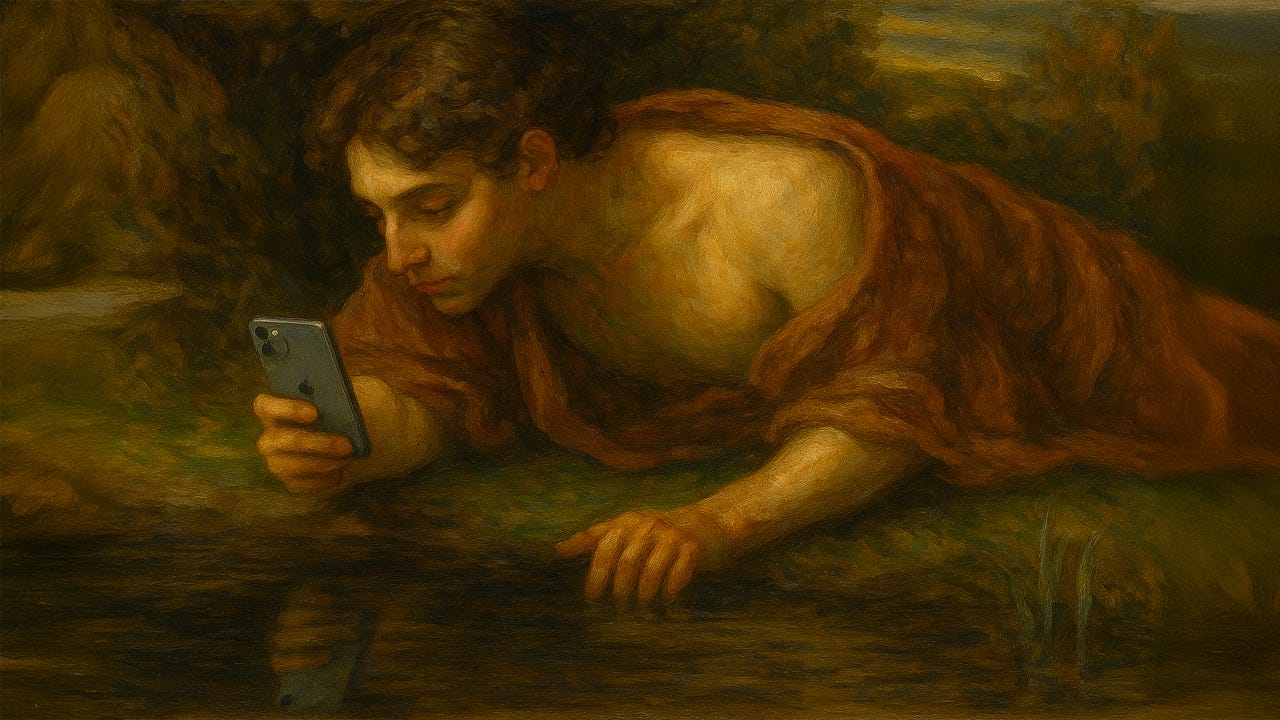
Imagination is dying because it is inconvenient. One of the worst things we have done as a society is rid ourselves of boredom. The device you are reading this on right now has enough distractions on it to keep your brain “stimulated” until you die. But to call it “stimulating” is misleading, because what is actually happening is your brain is being numbed. No one finishes scrolling and feels good about it. You come out of a coma-like state where you’re not sure what time it is, where you are, or even what you’ve been doing – most people can’t remember 99% of the videos they just finished watching. Sure, they weren’t bored during that time but by accepting a short term solution for boredom, we are also accepting the long term consequences of a world without imagination.
“Watch the way people watch TV, it’s hypnotic. Just sit back and you’ve got cable and ninety-five choices and you don’t really care much about anything else. Eventually, you don’t know about history, you can’t remember if there really was a Civil War, and eventually people get slaves again. You can have a President who basically reads cue cards and it seems OK, because he’s just like the guy on the series.” – Robin Williams, Actor, 1992
Imagination is like a muscle, the more you use it the stronger it gets. But technology is eliminating the need to use it because when your brain is being “stimulated”, it has no reason to be active. Not only can you scroll away boredom, a time ripe for imagination, but with advancements in AI, we’re outsourcing critical thought and creativity to a machine. We are creating the conditions where the imaginative muscle is atrophying, and in younger generations, it’s not even developing.
iPad kids are not just an internet meme, they are real. In generations past, when kids annoyed their parents, they would be told to go and play, to go and make something up, to figure it out, to use their imaginations to pass the time. Today, parents hand them an iPad, a digital pacifier that takes a child’s hyperactive, imaginative brain and numbs it. Kids today no longer play in worlds of their own invention, they play in worlds created for them. If a kid used to want to live out a sci-fi fantasy, they would have to imagine it. Now, all a kid has to do is turn on their tablet and someone has taken care of that for them. Play is no longer an active experience, it is a passive one dictated by someone else.
“I found that because there weren’t video games and this saturation of CG movies and all of this imagery in the media landscape, I had to create these images in my head, we all did, as kids having to read a book, and through the author’s description, put something on the movie screen in our heads.” — James Cameron, Director, 2010
But it’s not just kids, it’s everyone… we live in an iPad society. The elderly are doomscrolling Facebook, no one can go for a walk anymore without headphones, and people are even using AI to show them what books are describing instead of using their imaginations to picture something. Imagination is a byproduct of boredom, when your mind has nothing to stimulate it, it eventually comes up with something to fill in the blank. But in a world hellbent on achieving comfort and convenience, we’re not willing to sit with the discomfort and put in the effort required to use it.
As human beings, imagination is one of our most important assets, and without it, we stagnate. While we are using creativity all the time, we are not using imagination. Creativity is to create something from what already exists. Imagination is to create something from nothing. Creativity is iterative, imagination is innovative. In order to move our culture forward we need innovative ideas that break norms, solve problems, and create new things we didn’t even know we wanted. It takes imagination to see a future that is not just a slight iteration on the existing course, but rather a leap in an entirely new direction.
The problem is that the process of innovation is often boring. It’s long stretches of banging your head against a wall separated by tiny flashes of inspiration. While the feeling of an a-ha moment is unparalleled, it is far less consistent than the dopamine drip you get from social media. And because we’re wiring ourselves to have a “low boredom threshold” we no longer entertain the notion of doing nothing, we must, at all times, be doing something, even if that thing is scrolling our lives away on social media. Not only scrolling away your time, but scrolling away yourself. You are becoming who your algorithm is telling you to be, instead of who you’re capable of becoming.
Death By Algorithm
We are not going to stagnate, we are stagnating. If you want proof that imagination is dying, just look at the world… everything is the same. Our buildings are boxes in different shades of grey, inside every home is some variation of Ikea-chique, the content we consume all follows the same patterns – everyone is optimizing for the same thing: to reach as many people as possible, in the most efficient way possible, to make as much money as possible. And now that information is global, we’re all playing a similar game, with a similar hand, iterating towards a similar outcome.
As a result of trying to reach as many people around the world as possible, cultural imagination is being replaced by global sameness. Uniqueness isn’t a selling point anymore, instead we are opting for generic aesthetics that can appeal to anyone from anywhere. It’s no longer about exporting your culture to the world, but rather exporting things that any culture can enjoy. We are diluting culture so that it is easily packageable, sellable, and attainable.
“I think the culture has almost gone. It’s an awful thing for me to say because I’m a storyteller, an Australian storyteller. But I notice that for instance my children, as they grow up… they know so little Australian culture. It’s very, very hard to direct them towards it. And I’m a storyteller. I’m a practitioner. Which really worries me, I mean they know Halloween, they know Valentine’s Day, they know The Simpsons, they know every game that comes out of the United States. Every television show and every video. Every Disney Pixar movie, Dreamworks movie. They know all of those backwards. They know very, very little of Australian culture. And this is with parents like myself who are consciously trying to push it their way. And it’s very, very hard.” George Miller, Director, 2006
It’s not just our buildings and our furniture, it’s our people… we’re all becoming boxes in different shades of grey. To be a unique individual with distinct tastes and ideas is hard – it takes time, energy, and imagination to figure out who you are and what you care about. It is far more convenient to just be who you are told to be. And that’s what we’re doing, we are outsourcing our goals, desires, and beliefs to an algorithm – an algorithm that rewards content that is simple enough to appeal to as many people around the world as possible.
People have always conformed to what is popular, but in a global world there’s less nuance to that conformity. You are no longer influenced by what is popular in your surroundings, but instead by what is popular online, which is what is popular with everyone, everywhere. Our aspirations and aesthetics are homogenizing because our source of inspiration is the same as everyone else’s. And that source is incentivized to appeal to the lowest common denominator.
“There’s a very funny thing that has happened with golf swings – they’ve really homogenized. If you look at golf swings from like the 70s and the 80s, they were like, kooky and weird. It’s like, ‘How did you swing like that and win major championships?’ It makes no sense. And what has happened is with technology and really high-end instruction, the swings have become more homogenized. I think that something similar has happened in writing, as we’ve become so over socialized and constantly consuming, there’s been this homogenization, and you don’t have these sort of kooky and weird characters like you used to have… because we’re all swimming in the same milieu, people aren’t as distinctive as they used to be.” – David Perell, Essayist, 2024
Innovation does not come from conformity. It comes from those who not only believe that the world can be different, but those who believe they can make it change. Breaking away from the crowd is not an easy thing to do, people are going to look at you like you’re weird, they’re going to think you’re crazy… and that’s okay. You’ve got to be crazy to not only see a future for the world that no one else sees, but to take action to actually try and change it. When you spend so much time consuming content, not only does that pacify you into a state of inaction, but your beliefs will be primarily derived from content you see on the internet. You’ll see the world how everyone else sees the world, and there’s nothing innovative about that.
“Who made art history? Not the most reasonable people. The madmen did.” – Max Ernst, Painter, 1961
Rebirth
Imagination has not been taken from us, an alternative has been provided. Imagination is now optional and it’s dying because we’re choosing not to use it. In a society that optimizes for comfort and convenience, when the going gets even a little bit tough, we get our phones. We smother any chance of imagination we might have had in exchange for a quick solution. If your imagination is dying by choice, you can choose to bring it back to life… all you have to do is use it.
Imagination feeds off of discomfort. You are at your most imaginative when facing an obstacle you did not foresee, because you are forced to come up with ideas to get around it that you never would have thought of without it. It’s uncomfortable to have to step off the beaten path, but in order to realize your full potential you must go through discomfort. It is through discomfort that we make progress. In order to move our society forward, it takes the brave few individuals to go out on the edge of what is known and unknown, where there is no clear path, and find a way forward. In a world without imagination we don’t move forward, we move sideways because no one is imaginative enough to do anything different.
Q: Who are you seeing out there that are the next Spielbergs [and] Scorseses?
A: I never look at it that way because I really look at it as who is daring to buck the convention and really tell stories in a language that they have founded? Those are the kind of movies that really excite me. One of my favorite filmmakers today is Jordan Peele because he has found a way to take a popular concept right from the culture and give it the Jordan Peele spin… You find a really original thought inside every single one of his films and I think other filmmakers like Jordan – that’s really the hope for the future.” — Steven Spielberg, Director, 2023
If our hope for the future lies in those who dare to be different, then this is your call to be different. Do things that make no sense, have weird interests, be silly… you’re never too old to play. You are at your most unique when you are a kid, and it’s no coincidence that that is also when you are at your most imaginative. To figure out who you truly are, figure out the parts of you that you lost when trying to fit in – those are what made you unique. To stand out from the crowd you’ll have to be different from the crowd. You’ll never change the world by doing exactly what the world is already doing. Fight for your imagination like your life depends on it, because it does.
“From me to you, you got to be crazy. You know what I’m talking about, full goose bozo… You got to be crazy, you got to! Because madness is the only way I’ve stayed alive… You got to be crazy, it’s too late to be sane… you got to go full tilt bozo, because you’re only given a little spark of madness, and if you lose that, you’re nothin’... From me to you, don’t you ever lose that, because it keeps you alive.” — Robin Williams, Comedian, 1978