Crazy Versus Genius: Who Made Art History?
What Salvador Dali and paranoia can teach us about artistic brilliance.
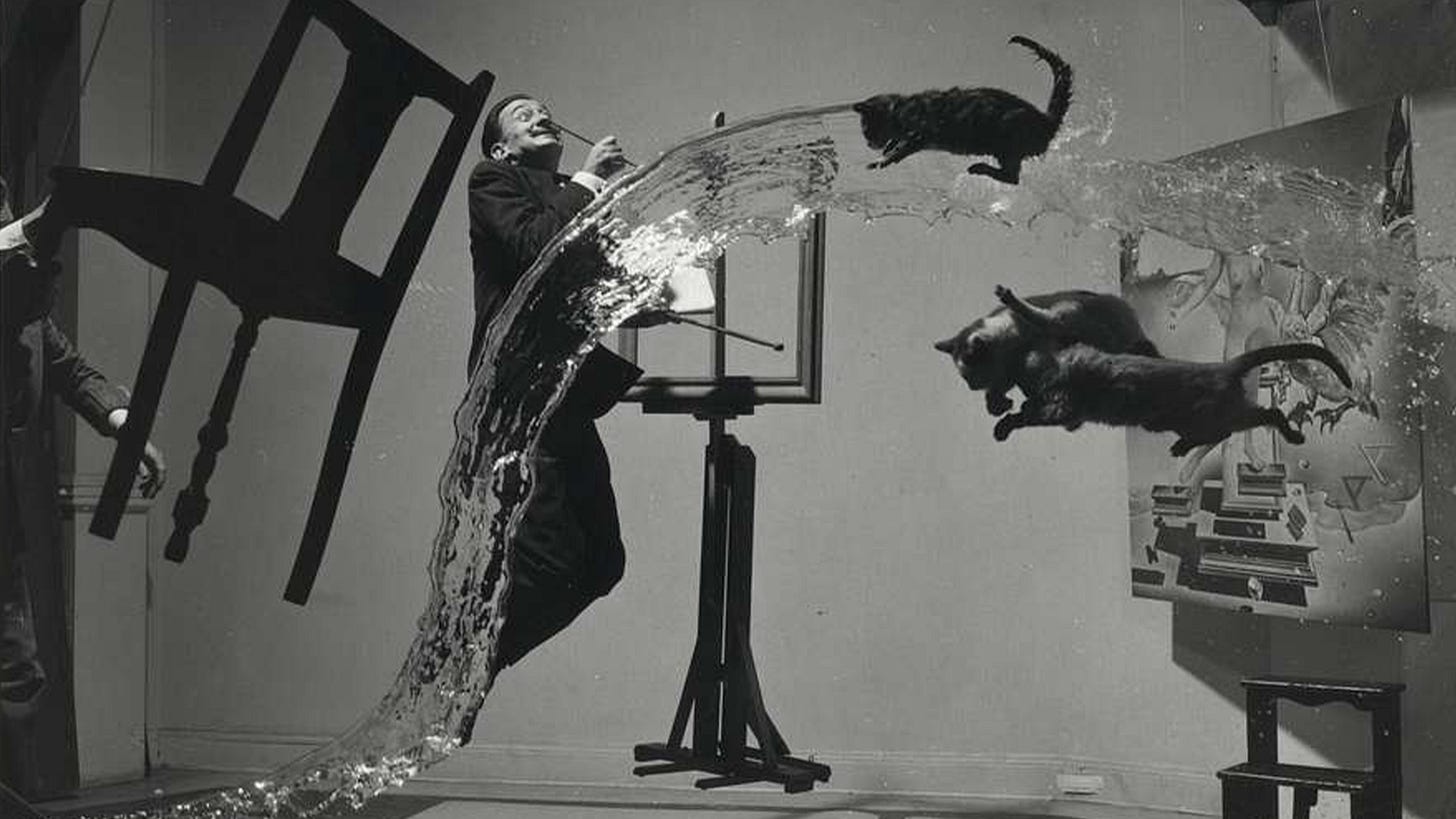
Crazy is a term often used to describe some of the greatest artists in history. Staunch supporters of the artists will rush to their defense with the usual rebuttal, “they’re not crazy, they’re a genius”. There’s no better example of a person who straddled the crazy/genius line more than the great surrealist painter, Salvador Dali.
“The only difference between one crazy man and Dali, is Dali is not crazy at all.” – Salvador Dali
Known in equal parts for his magically disturbing imagery and for his theatrics in the media, some regard him as a genius artist capable of moving in and out of disciplines with equal impact, who carefully crafted a persona the media would love enabling him to reach as many people as possible. While at the same time, others view him as an egotistical, self-aggrandizing maniac who would do whatever he had to for his own personal gain, regardless of how it impacted others.
No matter what your opinion of Dali is, we can all agree he was a bit of a weird guy whose paintings were even weirder. His aim was to dig deep into his subconscious and capture the deepest recesses of his soul on the canvas in as much detail as possible. According to him, he was able to do this through a process he invented called the paranoiac critical method.
“My whole ambition in the pictorial domain is to materialize the images of concrete irrationality with the most imperialist fury of precision.” – Salvador Dali
The only issue with the paranoiac critical method is that it could only be performed by Salvador Dali. Despite his best efforts to encourage other surrealist artists of the time to adopt his practice, no one could figure out how to do it. The reason for that is because there isn’t actually a way to do it. When performing the paranoiac critical method, Dali claimed he would lull himself into a paranoid state to use it as a source of creative fuel.
To be honest, it’s unlikely that Dali was actually driving himself crazy for the sake of his art. But that doesn’t mean that the paranoiac critical method doesn’t exist. In a recent interview with Artwell, world renowned Dali expert Nicolas Descharnes provides a reframe of the paranoiac critical method:
“It was even difficult for him to give a perfect, clear and simple definition, which I did later on. Now, this is my opinion, for me, the paranoiac critical method was: you register everything that happened, then you try to link them and it generates the creation. So the association is irrational, but the way he put it on the canvas, you make it rational to be able to explain it, to show it to the people.”
What Nicolas is saying here is that the paranoiac critical method was actually an intellectual and creative exercise. Dali’s method was to actively try and create links between unrelated events and objects in his life to see what his mind could come up with. When he would find a link, he would then paint an image that represented it. If you want proof that Nicolas’ interpretation of the paranoiac critical method is correct, look no further than Salvador himself. In the early 1930s, when he was inventing the method, Dali wrote this in a surrealist publication:
“I believe that the moment is at hand when, by harnessing the paranoiac and active component of our thinking processes, it will be possible to systematize confusion and contribute to the total discrediting of the world of reality.”
To Dali, paranoid people see the world in a way no one else does because they unintentionally connect different events in their life and draw conclusions no one else will. But because there’s no rational link between these disparate life events, it requires a certain type of creativity, and the suspension or discrediting of reality to find a connection. Dali wanted to tap into the creativity that was only reserved for those who are “crazy”, and he did so through the paranoiac critical method. He wasn’t actually entering a state of paranoia, he was just replicating a paranoid thought pattern by intentionally, or in other words, by using the active component of his thinking process to link unrelated events in his own life. In doing so he would create a different reality for himself and see the world in his own unique way which would lead to the creation of images unlike anyone else.
“I am not actually crazy. A psychiatrist in Paris worked for seven years to determine whether Dali is crazy or not. After many conversations he decided that Dali possesses one of the best organized brains he had ever encountered. He said that my brain contains the characteristics of paranoiac delusion structure; but paranoiac delusion, of course, is absolutely creative, the best kind of crazy. The whole difference between a crazy man and Dali is that Dali is not pathological. But even in true pathologic paranoiac delirium there exists some contact with reality. For instance, a good example of pathologic delirium: A man feels that his family is against him and that they want to poison his food. He begins to look around very closely at his family and discovers many things about them that are absolutely true. His fundamental assumption, of course, is wrong: Nobody wants to kill him. This is delirium and is crazy. But from this obsessional idea comes a marvelous quantity of perceptions of truth. He discovers many real things, thousands of insights and relationships that are unavailable to the average person, that usual people never perceive. Because I have this power of discernment, I discover things that other people could not possibly suspect exist.” – Salvador Dali, 1964
We use “crazy” as a catch all term for someone who doesn’t see the world the same way as we do. The problem with that, is that geniuses become geniuses because they don’t see the world the same way as we do. It’s easy to write someone off as crazy when we first come across them, and only later when we start to see the world their way do we recognize their brilliance. Therefore, if you see the world differently, the burden of proof falls on you to show the rest of the world that you’re right. No matter the field, whether it be science, mathematics, or art, you become a genius by being the first person to prove something new about the world.
“Look at the mouth of the girl in that painting on the wall, and at this lamp on the table, and at your hand on the recording machine. Most people see no connection between these things. But Dali, on the contrary, establishes immediately a complete system of interpretation relating these objects. The difference between Dali’s paranoiac delusion and the other kinds of craziness is his ability to communicate his visions of delirium to other people. This is the ability to see clearly, which is at the basis of every artist. The clearest such vision was that of Leonardo da Vinci, who could create, for example, an entire battle scene just by looking at random water spots on a damp wall—sometimes for an hour or more. This is the true paranoiac phenomenon, because if you can see something in this way, it is possible for you to tell other people “This is the nose of a man,” for example—and they will see it exactly the same as you. In the other kind of crazy it is the contrary: You may have a vision or a dream, but after it passes, you cannot communicate it to other people, because it is not systematic or organized. The most important thing in my life is this ability to organize systematically the most complex elements of my environment; to create a cosmos.” – Salvador Dali, 1964
In simple terms: both crazy people and geniuses see the world differently, but it takes a genius to be able to explain how they see the world in such a way that it makes sense to others. The act of being able to distill how you see the world isn't important so people don’t think you’re crazy, it’s important because by doing so you become the shoulders of giants that people stand on. Geniuses move the world forward, but they’re not able to do that unless other people are able to build upon their work.
“To be a genius it's not enough to be able to come up with a theory that only three men in the world can understand. To be a genius, you have to be able to come up with that theory and then explain it so clearly that anyone with a reasonable degree of intelligence can understand”. – Howard Bloom, 2023
Now, if someone is a genius and is able to move the world forward, that doesn’t mean they’re no longer crazy. When someone sees the world differently it’s never just in one way. They might create something that alters the course of humanity but that doesn’t mean they’ll no longer do things you think are weird. Michelangelo didn’t bathe, Einstein refused to wear socks, Beethoven poured water over himself to stimulate creativity, Tesla did toe curls to boost his brain cells, and Dali believed he was the reincarnation of his dead brother. Just because you become a genius doesn’t mean you stop being crazy.
The truth is, asking whether or not someone is crazy or genius is a trick question because you’re crazy until you’re a genius… and then you’re both. If you see things differently, everyone will call you crazy until you prove yourself right, at which point, you become a genius. The tricky part isn’t finding new ways to see the world, it’s convincing the rest of the world to see things your way.
“Who made art history? Not the most reasonable people. The madmen did.” – Max Ernst, 1961
Thanks for reading! If you’d enjoyed this essay, you’d love season one of the Artwell podcast where we profile the life and lessons of Salvador Dali. Available now on Apple, Spotify, or wherever you get your podcasts.