A Kind of Magic
Inside Freddie Mercury’s Creative Process
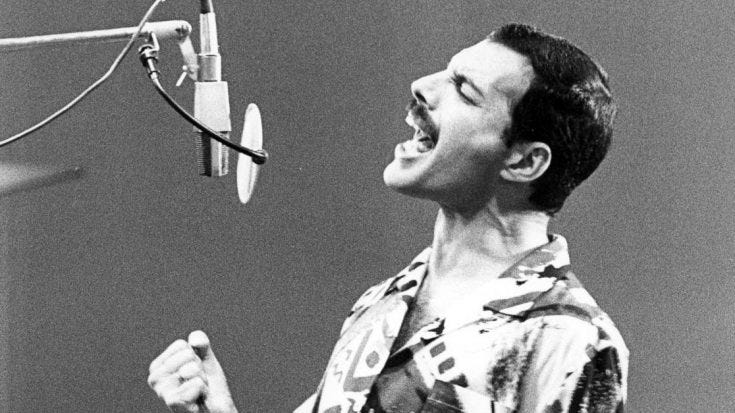
Freddie Mercury was one of the greatest frontmen in the history of music. He electrified audiences around the world night after night, taking tens, sometimes hundreds of thousands of people in the palm of his hand, literally. He could have you screaming at the top of your lungs one second and dead quiet the next using nothing but a hand gesture.
It’s a magical moment when thousands upon thousands of people are packed into a stadium singing a song that you wrote. What’s even more special is if you trace those moments back to their origin you won’t find thousands of people, you will find a single person in a room by themselves trying to find the right sounds that perfectly capture an emotion that is both deeply personal and universally understood.
Freddie Mercury was a master of this. His music is just as emotionally resonant today as it was in the 1970s. While the creative process is often an ambiguous exercise, we’re lucky that he spoke about his process enough that we’re able to put the pieces together to get a better understanding of how he made magic.
The Resistance is Your Guide
The “resistance” is a term coined by author Steven Pressfield that represents an internal, unseen force that prevents all creatives from sitting down and actually doing creative work. Most artists look at the resistance as something to overcome, Freddie on the other hand would use it as a guide. Song ideas had to come to him organically and flow out of him easily. As soon as there was any real level of resistance he would drop the song and move on to the next.
He didn’t look at his music as great art but rather as escapism for the masses. In order to make something that is widely consumable it has to be simple enough that everyone can enjoy it. Therefore, the resistance acts as a filter for complex and simple ideas. If a song is simple enough that it can be conceived easily then one can assume it can also be consumed easily.
“It’s escapism, and I want them to enjoy my music for that period of time. And then, when they don’t like it any more, they can just discard the damn stuff in the dustbin.”
What inspired a man who entertained millions? Monotonous, everyday life. There were never brainstorming sessions or lengthy periods at the piano trying to will the music out. He would just live his life and let the ideas present themselves. The tricky thing with this approach is the ideas leave you as fast as they arrive, so the moment you feel inspiration you have to drop everything you’re doing and get the idea down.
Waiting for inspiration to hit may seem like an inefficient way of creating and for most people it is. But Freddie Mercury was not like most people. His mind didn’t stop. He had more song ideas than he had time to work on them. Meaning that any time spent trying to force a song to come together was time not spent working on other, better ideas. His method was to get the music out of his head as fast as possible to see what he had in order to determine whether it was worth pursuing or not.
“I’ve been known to scribble down lyrics in the middle of the night without even putting the light on. I like to think that I write songs in lots of different ways, depending on my mood. Crazy Little Thing Called Love [1979], for example, I wrote in the bath. It took me five or ten minutes to write.”
Freddie Mercury’s “monotonous, everyday life” was quite different from most people’s. A common trap artists fall into is once they find success they’re no longer able to write in a way that their audience can relate to. Freddie didn’t have this problem because he didn’t write about his experiences, he wrote about his emotions. Emotion is universal, which is why his muse was how different experiences made him feel. Everyone can relate to feeling. No matter how much money someone has in the bank, they’ve been sad about a break up at some point.
“My strongest point is melody content. I concentrate on that first, then the song structure, then the words come after. The structure of the melody comes easy to me”
What makes a song emotional? If we look at the research paper ‘The influence of musical structure on emotional expression’ “tempo is typically regarded as the most important [component], but a number of other factors, such as mode, loudness, and melody, also influence the emotional valence of the piece.” Notice what’s not listed? Lyrics. Freddie knew this intuitively. When writing a song he would focus on the melody and structure with the words almost coming as an afterthought. Like most writers, Freddie didn’t like the idea of writing as much as he liked the idea of having written.
“I hate writing lyrics. I wish somebody else could do it. I wish I had a Bernie Taupin. Mind you, I like to do it all myself. I’m a greedy bitch.”
Feedback is Your Friend
Once Freddie had a song he believed in, the next step was presenting it to the rest of the band. Queen was unique in that all four members contributed songs for their albums. Naturally, this would result in having far more music than was needed for a record. The solution? Fight about it. The boys would argue, bitch, and moan, until they democratically whittled down all available material to the best grouping of songs. It required a certain level of humility to accept that one of your songs just wasn't up to par but what ultimately came out of these rows is an iconic discography that has stood the test of time.
While this may seem like an immature exercise, it was a critical part of Freddie’s creative process. He needed to have people who weren’t afraid to push back on his ideas - to find their deficiencies, so he could make them better. When he did his solo albums he didn’t have that. He was surrounded by yes men who were all too afraid to provide any criticism and as a result his work suffered. It was important for him to be able to stress test his material with people he respected to know if he really had something or not.
“Roger, Brian, John and I all write separately and battle to get as many of our own songs as possible onto each album. There’s a push, a hunger, a constant fight, which is very healthy. We slug it out and in the end it’s very democratic. I don’t want to hog things. I mean there is no way I want to say that only I can write the songs. You have to go on the strength of the songs only.”
When it came time to record, Queen gave it everything they had. Most bands come into the studio and record like they’re making an album. Not Queen. They would bring their world renowned stage presence into the studio and perform like they were playing for 100,000 people. That energy can be felt in each and every record.
The benefit they had in the studio over a live performance was that they could fix their mistakes. And they would. Again… and again… and again. Freddie was a perfectionist and he would make himself and his bandmates repeat a small section of a track until it was just right. He was uncompromising and would do everything in his power to get a song as close to perfect as possible.
“This was undoubtedly driven by his perfectionism. Freddie knew in his mind exactly what he wanted, and was prepared to throw a tantrum to make sure everything went the way he desired . . . Freddie knew the value of the tantrum.” – Leslie-Ann Jones, Bohemian Rhapsody: The Definitive Biography of Freddie Mercury
For Freddie, the music was above all else. This included his feelings, your feelings, what did well in the charts, what their management told them to do, what they had budget for… everything. His priority was making the best record imaginable, pushing beyond what they had done before. He didn’t just give the audience what they asked for, he’d give them what they didn’t even know they wanted. If Freddie felt that weaving opera into a rock ’n’ roll song made it better, he’d do it. It didn’t matter if everyone else said otherwise. He would always do what was best for the song.
Your Art Isn’t For You
The last creative decision Freddie made was to not to tell anyone what his lyrics meant. He would always deny any meaning in his music when asked by journalists. It was his wish that everything he created be open to interpretation. That way each and every person could have their own unique experience when listening to one of his songs. He knew that once he put his art out into the world it was no longer his. It was for his fans to have and do with as they wish.
“I don’t like to explain what I was thinking when I wrote a song. I think that’s awful. That’s not what it’s all about. I don’t like to analyse it. I prefer people to put their own interpretation upon it – to read into it whatever they like. I just sing the songs. I write them and I record and produce them, and it is up to the buyer to interpret it the way that he or she feels. It’s not up to us to come up with a product and label it. It would be so boring if everything was laid out and everybody knew exactly what it was all about all the time. I like people to make up their own minds.”
Freddie Mercury never did anything he didn’t want to do. He was uncompromising and would only follow his interests and urges in all areas of life. How he made music was no exception. He would follow whatever excited him, create what came most naturally, and refused to compromise on his vision. It’s in this unflinching belief in himself and his art that led to some of the greatest music that’s ever been made.